

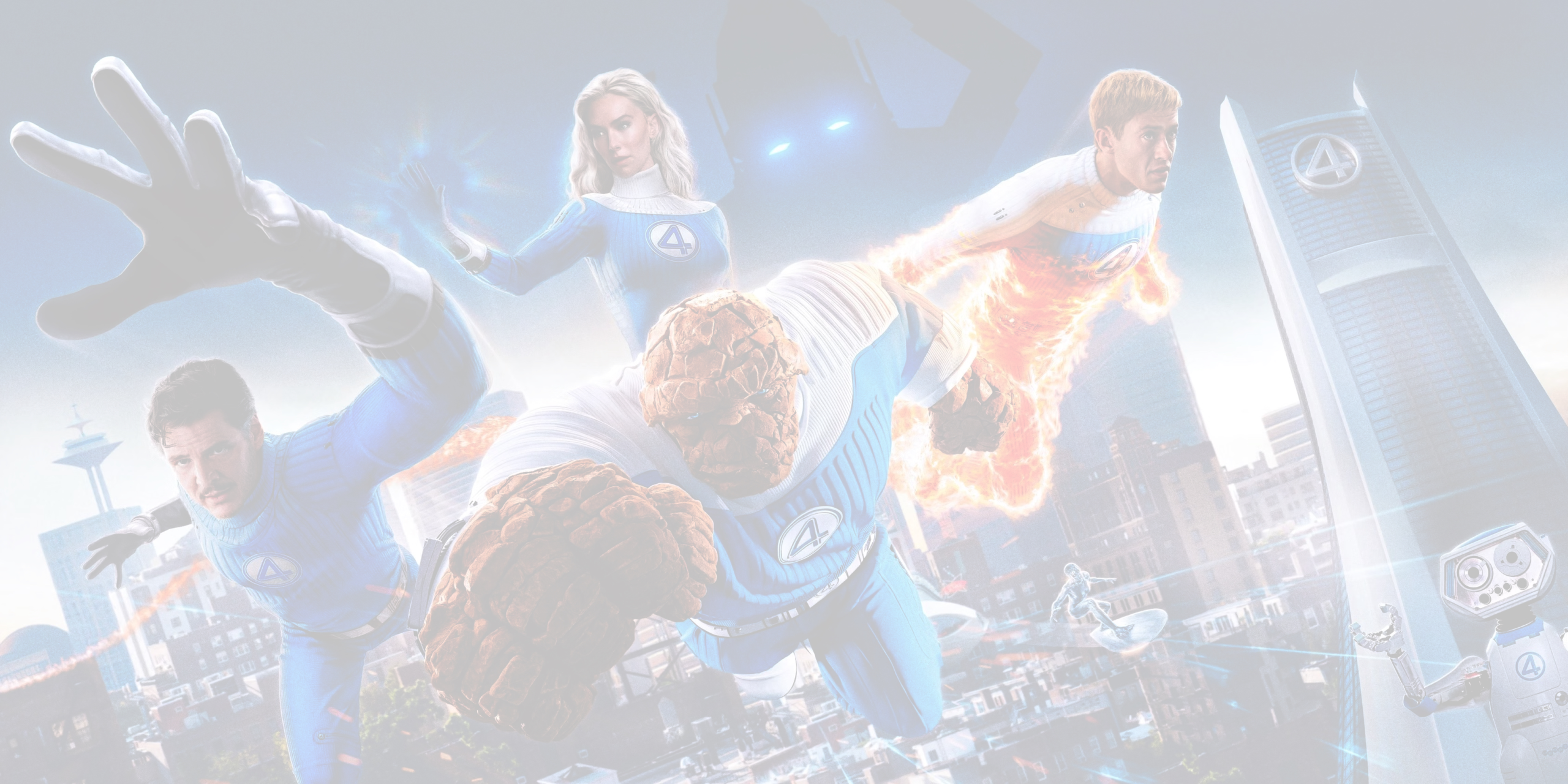
Superhero fatigue has firmly taken hold of audiences since the COVID-19 pandemic. With Marvel Studios and DC Comics churning out multiple movies and TV shows each year, keeping up has been a chore. While many criticisms have been made, ranging from franchise overexpansion to the lack of clear direction, the core issue is simple: weak writing. You can blame industry strikes, efforts to broaden appeal, or cinematic overload, but there is no handouts for poor writing. I’m not here to break down every writing flaw (though they span themes, pacing, plots, characters, etc. —writing!). In fact, I could’ve written this piece without even mentioning the genre’s decline, but I bring it up for one reason: Marvel’s newest addition to their franchise, The Fantastic Four: First Steps, is actually quite good. Compared to recent entries, its values, visuals, score, and yes, its writing, all stood out. That said, if you haven’t seen it yet, stop reading now. It’s one of the strongest superhero films in years, and you’ll want to go in fresh.
A central plot point in the film centers on the concept of teleportation. Early in the story, Reed Richards, the superhumanly brilliant, elastic member of the Fantastic Four, successfully teleports an egg across his lab. The scene offers no explanation at first, but later the film reveals the fictional physics behind the technology. This groundwork becomes crucial when Galactus, the towering, ominous antagonist, threatens to destroy Earth unless the Fantastic Four surrender their newborn child. With no realistic way to defeat Galactus or dismantle his ship, Richards proposes a desperate alternative: unite the world’s nations to construct a massive teleportation device capable of relocating Earth to another solar system.
The film’s central scientific challenge is the teleportation of Earth—quite a feat! Worry not, for a brief montage of scientific ingenuity will solve the issue in no time. Even if we accept the premise that teleportation via a wormhole is possible, there’s more at stake. A wormhole, simplified, can be imagined by treating spacetime as a flat sheet—fold it in half, punch a hole through, and you’ve created a shortcut between two distant points. Though entirely theoretical, let’s grant that “Earth 828”—Earth of an alternate universe where the movie takes place—has mastered this technology. Still, there’s one glaring issue: Earth can’t just be dropped anywhere in the cosmos. For life to exist, the planet requires astonishingly specific conditions. Without them, survival is hopeless.
It’s easy to miss, but the movie, once again to its credit, briefly addresses this issue, as Richards states, “Starting immediately, we will create teleportation bridges spanning the globe. They will be synchronized and interconnected, capable of transporting our planet to a new solar system within a 2% margin of the inhabitable zone.” I’m not sure what’s more impressive: that Reed Richards managed to master wormhole technology, or that he somehow scanned the entire universe from Earth just a few years after humanity’s first steps into space. No interstellar spacecraft, no deep-space telescopes, just pure genius. . . I guess. The film doesn’t suggest teleporting Earth to just any random spot in the universe; it makes clear that a suitable solar system was required and found. But that raises a deeper question: just how unlikely would that be? Assuming their universe mirrors our own, our present task is to consider the vast cosmic real estate Richards would’ve had to sift through, because for life to continue uninterrupted, the new location would have to match Earth’s conditions with near-impossible precision.
First, the new solar system would need a single parent star, like our Sun. Without a star, Earth would freeze; but placing it in a binary or trinary star system could destabilize its orbit, causing extreme climate fluctuations or even orbital collapse. But it’s not just the number of stars that matters; the distance from the star is equally crucial. Earth orbits a medium-sized star within a narrow band called the “Habitable Zone.” Too close, like Venus, and Earth would become a scorched wasteland; too far, like Mars, and it would freeze. Even the star’s chemical makeup must be just right: rich in life-supporting elements like carbon and oxygen, but without an overabundance of heavy metals that produce harmful radiation. Canadian astrophysicist Hugh Ross writes, “The difference between preparing a tent for a few nights and preparing to build the Wilshire Grand Center in Los Angeles or 432 Park Avenue in New York reflects the difference in what is at stake. Failure to notice a bit of slop or some rocks and roots or a nearby swelling stream may lead to an uncomfortable night’s sleep when camping. However, even the slightest miscalculation in preparation for construction of one of these towers could cost lives.” Similarly, a misstep in selecting a new home for Earth could spell disaster for all life on Earth. But we’ve only begun.
But it’s not just our Sun that makes Earth’s cosmic neighborhood uniquely suited for life. The gas giants—Jupiter and Saturn—serve as massive gravitational shields. Their immense size and mass, and thus their much stronger gravitational pull, allow them to deflect or absorb asteroids and comets that might otherwise collide with Earth. Remove them, or relocate Earth to a region without similar protection, and the risk of catastrophic impacts increases.
Mr. Richards really should have sent some teleportation devices to the Moon, too, as it stabilizes Earth’s axial tilt, which keeps the seasons from swinging into extremes. Without it, we could face brutal, unpredictable climate shifts.
Had the Fantastic Four teleported Earth that met these conditions, they could have very well still landed it in a dense cloud of dust, where sunlight would be blocked and life itself threatened.
Even Earth’s magnetic field, generated by its molten outer core, offers no guarantee of safety if the planet is placed in the wrong part of the galaxy. In more volatile regions, such as near pulsars or black holes, the intense radiation would overwhelm our natural defenses, bombarding life with deadly cosmic rays. This highlights an even bigger point: Earth’s placement within the Milky Way is just as critical as its spot in the Solar System. Just as we orbit in the Sun’s “Habitable Zone,” we also reside in a calm region of the “Galactic Habitable Zone”—far from the dangerous galactic center, where blackholes, clustered stars, frequent supernovae, and high-energy radiation govern without remorse.
Astronomer Donald E. Brownlee and geologist Peter Douglas Ward, in their book Rare Earth, emphasize, “When we study ‘habitable zones—for animals as well as microbes, and in the galaxy and Universe as well as around the sun—leads to an inescapable conclusion: Earth is a rare place indeed.” The odds of finding another star just like our Sun, in a similar safe orbit, with similar cosmic neighbors, and in a peaceful part of the galaxy are remarkably low. In their haste to save Earth, they might have doomed it instead.
While no one seriously believes you can teleport Earth anywhere in the galaxy and expect life to go on unchanged, stories like this can subtly downplay just how extraordinary our planet’s placement truly is. Earth’s position and the countless factors that make life here possible are anything but ordinary. Astronomer Guillermo Gonzalez puts it aptly: “Given the recent trends in the planetary sciences, perhaps we should begin to view Earth and its immediate surroundings. . . as a finely tuned and interdependent system that together nurtures a strange little oasis. Like the baby bear’s porridge, Earth is, once again, just right.” We don’t live on just any cold rock in space; we inhabit one remarkably tailored for life. It’s enough to make you wonder—both in awe and in question. To wonder at the sheer beauty and precision of it all, and to wonder why. . . or Who made such privilege possible.
References:
- Gonzalez, G., & Richards, J. W. (2004). The privileged planet: How our place in the cosmos is designed for Discovery. Regnery Pub. ; National Book Network distributor.
- NASA. (n.d.). NASA astrobiology. NASA. https://astrobiology.nasa.gov/news/galactic-habitable-zones/
- NASA. (2025, March 24). The habitable zone – NASA science. NASA. https://science.nasa.gov/exoplanets/habitable-zone/
- Ross, H. (2017). Improbable planet: How earth became humanity’s home. Baker Books.
- Ward, P. D., & Brownlee, D. (2003). Rare earth: Why complex life is uncommon in the universe. Copernicus.