

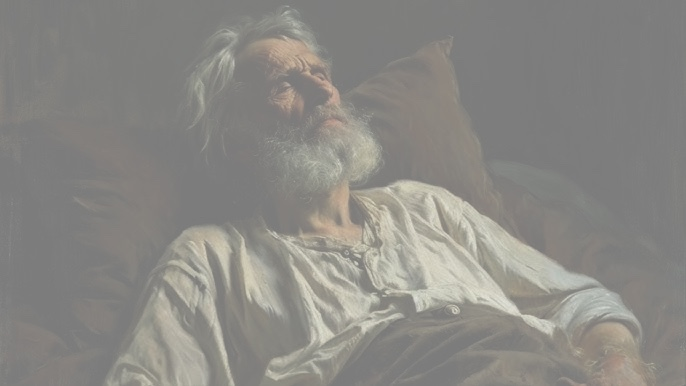
Arguably, the greatest plot twist in literary history lies within the pages of Leo Tolstoy’s 1886 novella, The Death of Ivan Ilyich. Now, if you don’t want any spoilers, go read the first two sentences of the novella, for the twist strikes in the third: “Gentlemen,” he said, “Ivan Ilyich has died!”
The novella consists of 12 chapters, the first recounting the funeral of Ivan Ilyich, and then Chapters Two through Twelve going back to recount his life leading up to his impending death. After an accident caused severe internal damage, he suffered terribly for his final months and years. It was during this time that he slowly began to accept his fatal fate and, in turn, question what he had deemed important in life. Ivan Ilyich’s philosophy of life had rested on two central pillars: social standing and comfort. His career is pursued primarily for the prestige and status it confers, elevating him in the eyes of society. Propriety drives him to maintain a substantial household filled with aesthetically pleasing decor that mirrors the latest trends, as these reflect the success of his professional life. Social approval is equally vital, as Ivan Ilyich, an ordinary man, seeks to blend in, be liked, and avoid conflict, never stepping on anyone’s toes to preserve his agreeable image. Comfort shapes his choices too, evident in his marriage, which he initially views as a means to bolster his social position, only to disengage when the challenges of family life disrupt his ease. These two pillars—the desire for comfort and social standing—are ubiquitous in the human condition.
Curiously, people across time, voices online, our acquaintances, or even ourselves seem to understand that worldly pursuits often fail to bring fulfillment. This truth is vividly illustrated by two points in the narrative: Ivan Ilyich’s funeral and his deathbed. At his funeral, his colleagues are fixated on the vacancy his death creates and the prospect of their own promotions. His wife, meanwhile, is preoccupied with securing the largest possible inheritance from Ivan Ilyich’s estate. Even his closest peers, though pensive, quickly turn to distractions like card games. As for Ivan Ilyich himself, his final days are marked by isolation. Dying in agony, he becomes an inconvenience to those around him. No one offers genuine pity. Internally, he pleads for someone to empathize with his suffering, but his pain is met with indifference and worse—deliberate avoidance, as true empathy would demand action. Ivan Ilyich likens himself to a foul odor entering a room, an unpleasant presence to others. As death approaches, he grapples with a haunting question: Did he live a meaningful life? Reflecting on his life, he initially insists he did everything right. He must have. He adhered to all of society’s expectations. Yet, this conviction crumbles as he confronts the unshakable truth that his life lacks fulfillment. There is no grand life-altering transformation for Ivan Ilyich, only a slow, painful realization that something fundamental was amiss. In the novel’s closing moments, as he breathes his last breaths, he sees the light—a wash of joy as he celebrates his passage. Yes, that’s the word, his passage. “Death is finished.”
While the preceding analysis offers valuable insights, and even if it were the sole takeaway from the novel, it would be significant, I believe it captures only part of Tolstoy’s deeper message. Unfulfillment and living for the wrong reasons are only symptoms of a much deeper condition. I believe Tolstoy’s true thesis extends beyond the emptiness of a life driven by superficial pursuits; he argues instead that we deem ourselves immortal. Allow me to prove it and demonstrate why this interpretation is both more profound and transformative.
In Chapter One, at the funeral, the narrative details:
“Besides considerations as to the possible transfers and promotions likely to result from Ivan Ilyich’s death, the mere fact of the death of a near acquaintance aroused, as usual, in all who heard of it the complacent feeling that, ‘it is he who is dead and not I.’ Each one thought or felt, ‘Well, he’s dead but I’m alive!’ But the more intimate of Ivan Ilyich’s acquaintances, his so-called friends, could not help thinking also that they would now have to fulfil the very tiresome demands of propriety by attending the funeral service and paying a visit of condolence to the widow.”
Peter Ivanovich, one of Ivan Ilyich’s closer colleagues, does just this, and having visited the widow and learned about the details of Ivan Ilyich’s prolonged suffering, it momentarily horrifies him as he contemplates his own vulnerability, but he quickly reassures himself by separating his fate from Ivan Ilyich’s:
“The thought of the suffering of this man he had known so intimately, first as a merry little boy, then as a schoolmate, and later as a grown-up colleague, suddenly struck Peter Ivanovich with horror, despite an unpleasant consciousness of his own and this woman’s dissimulation. He again saw that brow, and that nose pressing down on the lip, and felt afraid for himself. ‘Three days of frightful suffering and the death! Why, that might suddenly, at any time, happen to me,’ he thought, and for a moment felt terrified. But—he did not himself know how—the customary reflection at once occurred to him that this had happened to Ivan Ilyich and not to him, and that it should not and could not happen to him, and that to think that it could would be yielding to depressing which he ought not to do, as Schwartz’s expression plainly showed. After which reflection Peter Ivanovich felt reassured, and began to ask with interest about the details of Ivan Ilyich’s death, as though death was an accident natural to Ivan Ilyich but certainly not to himself.”
If we skip ahead to Chapter Four, as his illness tightens its grip, Ivan Ilyich grapples with a logical syllogism about mortality. He acknowledges its validity yet remains convinced that death is a fate reserved for others, not himself.
“In the depth of his heart he knew he was dying, but not only was he not accustomed to the thought, he simply did not and could not grasp it. The syllogism he had learnt from Kiesewetter’s Logic: ‘Caius is a man, men are mortal, therefore Caius is mortal,’ had always seemed to him correct as applied to Caius, but certainly not as applied to himself. That Caius—man in the abstract—was mortal, was perfectly correct, but he was not Caius, not an abstract man, but a creature quite, quite separate from all others. He had been little Vanya, with a mamma and a papa, with Mitya and Volodya, with the toys, a coachman and a nurse, afterwards with Katenka and with all the joys, griefs, and delights of childhood, boyhood, and youth. What did Caius know of the smell of that striped leather ball Vanya had been so fond of? Had Caius kissed his mother’s hand like that, and did the silk of her dress rustle so for Caius? Had he rioted like that at school when the pastry was bad? Had Caius been in love like that? Could Caius preside at a session as he did? ‘Caius really was mortal, and it was right for him to die; but for me, little Vanya, Ivan Ilyich, with all my thoughts and emotions, it’s altogether a different matter. It cannot be that I ought to die. That would be too terrible.’”
The only individual in the novella who acknowledges death as an inevitability to the self is Ivan Ilyich’s servant, Gerasim, who helps Ivan Ilyich with his physical needs during his illness. When Ivan Ilyich sends him away, Gerasim expresses a view that contrasts with deeming oneself immortal; instead, he accepts that death happens to everyone, including himself, which motivates his kindness:
“Once when Ivan Ilyich was sending him away he [Gerasim] even said straight out: ‘We shall all of us die, so why should I grudge a little trouble?’—expressing the fact that he did not think his work burdensome, because he was doing it for a dying man and hoped someone would do the same for him when his time came.”
Forgive my mistake, but there is one other person who acknowledges that death also applies to himself, and that is Ivan Ilyich, at his very end. The moment death’s reality takes hold, he acknowledges the meaninglessness of his life—when it’s too late.
This analysis prompts two critical questions. First, if acknowledging one’s mortality instills an incentive to live a life full of meaning, then what is a life full of meaning? And second, how often, then, should we think about death? Perhaps the second answers the first. I propose that we should reflect on death as frequently as possible. As Peter Ivanovich, one of Ivan Ilyich’s close acquaintances at the funeral, observes, even when we encounter death—whether through a friend, family member, pet, movie, video game, or the constant stream of deaths in the news—we tend to distance ourselves from its reality. There is a profound difference between merely witnessing death and internalizing its inevitability. We have the unique opportunity to imagine ourselves on our deathbed before we arrive there. So, consider: If I were to evaluate my life today, are there aspects I would regret if they remained unchanged? As death nears, regrets and satisfactions take on a magnified significance, reflecting on the grander scope of our actions—jobs, interactions, habits, relationships, to name a few. If you live a life of remarkable integrity but lie once, I can’t imagine that single lie will haunt you in your final moments. I mention this because I find that we often underestimate the weight of small habits, dismissing them as trivial. For example, I’ve long thought it would be meaningful to consistently open the car door for my fiancée. Yet, more often than not, I don’t—not out of malice or lack of desire, but because, in the moment, it feels easier or convenient to skip it. It’s just one time; I’ll get it next time. Upon reflection, however, I see that this has become a habit of omission, a pattern I’ve unintentionally adopted. While these moments may seem inconsequential now, they could coalesce into a larger regret. Most individuals understand this. You are your habits. But what drives us to cultivate them? Is it merely to live a more fulfilled life for our own sake? I believe it’s more profound. When we confront our mortality, something transformative stirs within us. On our deathbed, reflecting on a choice like setting aside money to donate to a cause won’t evoke pride but a deep sense of fulfillment—a recognition that we prioritized something greater than fleeting pleasures, which, in that final moment, hold no meaning.
This leads to the second question I raised: what choices, whether grand or small, should guide our lives when we reflect on death? At first glance, this might seem akin to the popular saying “YOLO” (You Only Live Once), which urges us to seize the moment and embrace adventure. Yet, despite their apparent similarity, YOLO feels hollow, offering no real direction. It’s a true but trite. While the saying uses the word “live” or “life,” death would be its contrary. And death offers guidance. How? Well, it might not be so direct. I could live my life through the lens of wanting to die with a good sum of money, have lots of friends and be liked by them, have a family, enjoy my job, have fun game nights, live in a nice home, and live every day enjoyably. That seems like a pretty good, normal life. This was the exact life of Ivan Ilyich. Are those things bad? Tolstoy is not arguing they are. Rather, on one side of the coin, what brings meaning to life is not your social status, comfort, or material possessions, and on the other, because these are ultimately meaningless, why should we distress over them? Should we just not believe what nearly every celebrity, every mentor, every psychologist, every study, and stories like The Death of Ivan Ilyich, which has resonated for nearly 150 years precisely because of this insight, tell us? Should we continue to prioritize social status and comfort over more important matters? Well, what are those more important matters? Tolstoy doesn’t seem to offer answers. My present task is not to provide a life guide, but to advance the same message that Tolstoy did: know you are mortal. And don’t just know that you will die—we all know this—but feel it. If this notion seems cliché, you’re still severed from it; it should be terrifying. Don’t wait until your final days to accept it. Time moves relentlessly forward, your life will fade, and no amount of regret can undo the past. So accept it now, before every decision. You might view this as a grim lens through which to live, constantly aware of death’s closing shadow. Or you can see it as an opportunity: with the time you have left, you can shape yourself into the person you’ll wish you had been when that final moment arrives. Arguably, the most life-giving thing you can do today is to stare death in the face and welcome it in.
Much more could be said on this topic. Accordingly, next week I will continue exploring the acceptance of mortality in a more systematic and practical way, analyzing it through the lenses of ethics and Christian doctrine. Dark. Uninviting. Iconoclastic. Perhaps. No one wants to speak in this manner. But only in darkness do we most discern the light.