

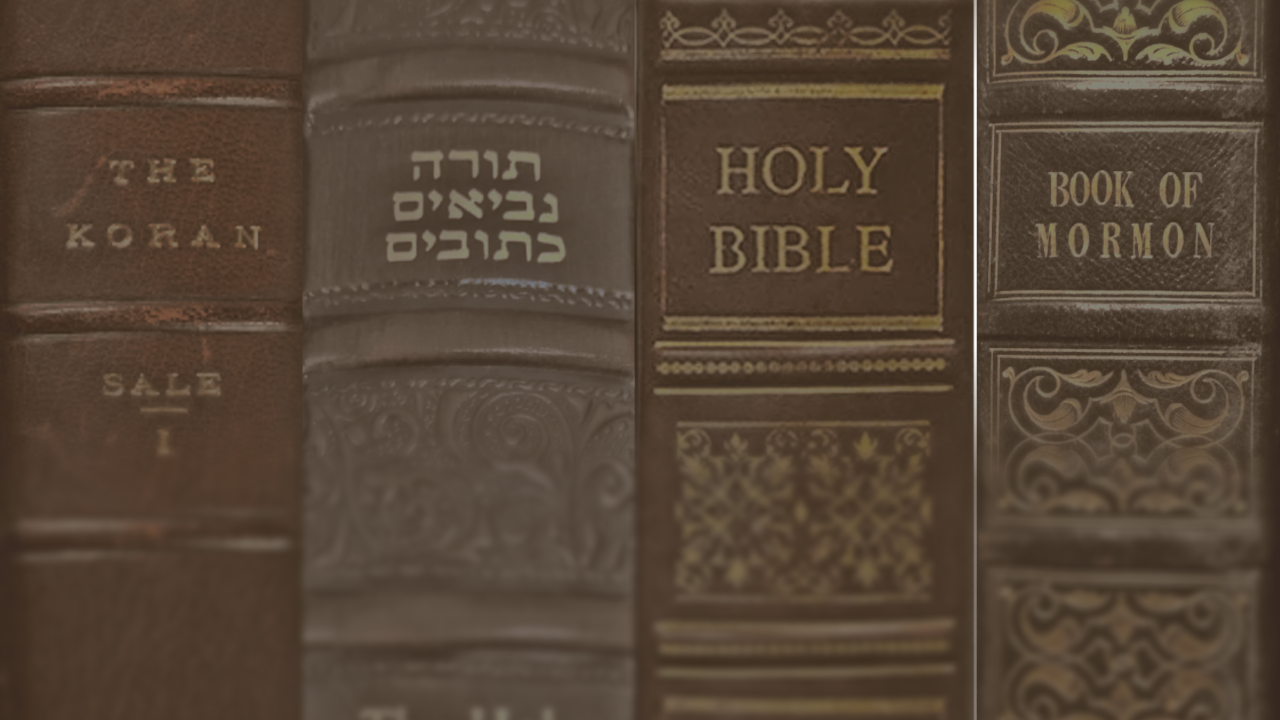
Browsing the shelves of theology books at my local used bookstore, I came across a small, black leather-bound copy of the Book of Mormon. Whether I ended up purchasing it because it was something I actually desired to read right now or because it was only forty-eight cents, it is something I had never read before but always have had a natural curiosity about, considering my close acquaintance with its formative predecessor, the Bible. The next day I opened it and read the first book, 1 Nephi. When I closed it, I thought, Hmm, what else do I want to read now? The Book of Mormon had only fueled my caprice for religious texts I’d never touched, but with no other copies at hand, I turned to a PDF online and began “The Opening (Al-Fatiha)”—the first chapter of the Qur’an. It wasn’t for another two days that I found myself having inadvertently read the Book of Mormon, the Qur’an, a textbook on Systematic Christian Theology, and a commentary on the Book of Exodus by a Jewish writer (the latter two I was already reading, and the Jewish commentary I was not seeking Jewish insight but the specific Jewish writer offers great exegesis). In other words, I am now reading representatives of the four major religious worldviews in America: Christianity, Judaism, Islam, and Mormonism.
Thus, I break the threshold of four traditions, with Jesus Christ positioned at the center of history, the Torah offering an ancestral perspective whose fulfillment would later be Christ, and the Qur’an and the Book of Mormon standing as the newest territories—each building in its own way upon the two predecessors: the Book of Mormon fully adding on, and the Qur’an acknowledging certain providential elements of them while omitting the primary doctrines and establishing a new set in their place.
And so it is duly acknowledged that I proceed with a burden of preexisting convictions and presuppositions, rendering my reading far from neutral. Fortunately, and certainly most justly, I do not read with any prompt in mind or assignment whereby refutation is my lens, but simply with a goal to humbly hearken to the words that have proved influential by any stretch of the word. The task, then, is not to empty myself of belief, but to hold it with sufficient modesty that the self-witnessing authorities each claims might speak out.
Notwithstanding this receptivity, the divergent doctrines must be scrutinized in their persuasiveness given their exclusivity. That is, because these texts do not deal in mere ideas but make revelatory claims about all reality, they are hence incompatible—not necessarily concerning salvation, but in their core doctrinal claims. And if my math is correct, at least three of the worldviews must be wholly mistaken. A problem of arithmetic can be mistaken, a capricious impulse can be mistaken, but when eternity tears into time and God is claimed to have spoken, if such claims are mistaken, they are not harmlessly so. But if one is true, a personal demand is undoubtedly laid upon us.
An analysis may have its place down the line, but for now, while an intake of competing ideas often leads to fickleness, my hope in confronting these texts is quite the opposite in all regards: clarity.