

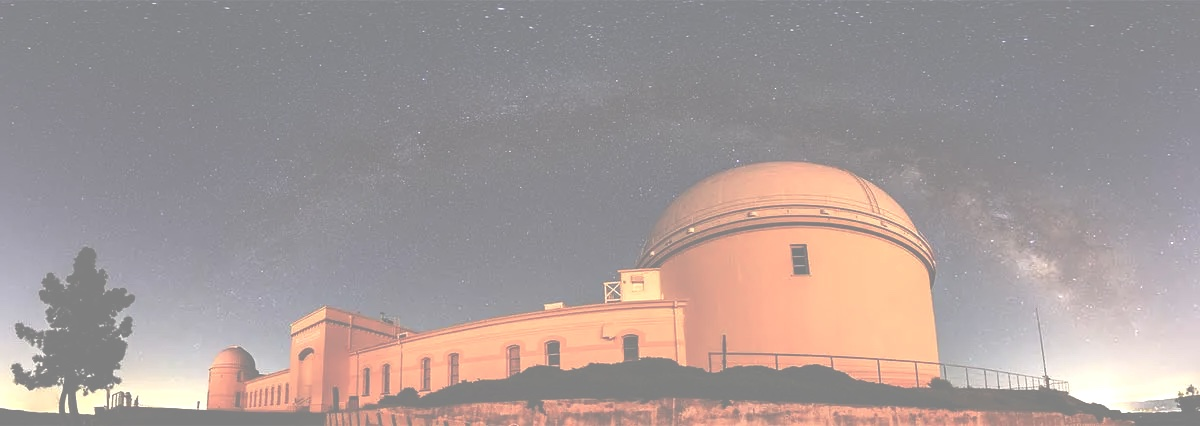
Back in 2024, I visited the Lick Observatory, founded in 1888 and one of the world’s first mountaintop observatories. There, I attended a lecture by astrophysicist Jorge Moreno, a professor at Pomona College. His main area of study that he presented was what is known as dark matter. Pay close attention as I describe what dark matter is and how astrophysicists came to discover it.
Everything in the universe is made of matter: you, your house, Earth, the sun, everything. However, when scientists study the universe and the galaxies within, they encounter an interesting phenomenon: there should be more matter. Imagine you’re taking a walk through the park and come across a group of kids playing on a merry-go-round. You can see the kids (the visible matter, like stars and gas in galaxies), and if you were to calculate how many kids there are, how much they weigh, the structure of the merry-go-round, and how much force they are pushing it with, you could predict precisely how fast the merry-go-round should be spinning. But in this case, as you view these kids playing on it, the merry-go-round is spinning much faster than it should, and another oddity is that the kids aren’t even flying off. The only conclusion is that something invisible must be holding it together, adding extra “weight” to keep it stable. This is a similar phenomenon to what astrophysicists began to observe starting in the 1930s—galaxies rotate too fast, and clusters move too cohesively to be held together by the gravity of visible matter alone. Accordingly, scientists have concluded that there should be about 27% more matter than that which is visible. The leading hypothesis is that this 27% gap of matter actually is there, but we just don’t see it. Hence, it’s been dubbed “dark matter,” not because it denotes an evil, looming force, but because it doesn’t emit or reflect light. The dark matter hypothesis is not just a gap-filler, though, as some evidence has presented itself. Einstein showed that light from faraway stars bends around massive clusters of matter due to gravity (called gravitational lensing), and the bending of light is occurring at a much stronger scale than what the visible matter alone can cause, leading scientists to infer the presence of invisible dark matter. Moreno leads in creating simulations to model how dark matter influences galaxy formation and mergers, and he presented many of these visualizations during the lecture I attended. Dark matter is still, nevertheless, a hypothesis, as scientists have no idea what this hypothetical matter is made of. As I sat through this lecture, I couldn’t help but draw a parallel: by conducting scientific experiments and observations, in light of the discrepancies between what we should expect about our universe and evidence for its existence, scientists concluded an invisible, intangible substance whose composition is unknown yet nevertheless has a binding and causal explanation for events. Oh, but God? No, He can’t exist.
Before you object to the correspondence, let me acknowledge that I recognize their differences, but I also recognize their similarities. The correlation between dark matter and God is different because one infers a natural explanation, while the other a supernatural one. However, they are similar in their methodological approach.
The methodology employed is a form of logical inference called abductive reasoning, more commonly referred to as the method of multiple competing hypotheses. In short, this approach starts with observations, posits and scrutinizes possible explanations, and proposes the most likely explanation for them, even if it’s not directly proven. Let’s look at a simple example. You come home from work and observe that the TV is on. Here are the competing hypotheses as to why the TV is on: 1) You forgot to turn the TV off when you left for work. 2) The remote fell off the couch and landed at an angle that caused the ground to hit the power button. 3) Someone broke into your house and turned the TV on.
These are three logically possible explanations, but let’s now look at the information we know: You watched TV this morning, the remote is still sitting on the couch, and nothing has been stolen. While we can’t “prove” it, we can confidently infer, after having examined multiple competing hypotheses, that you forgot to turn the TV off when you left for work.
Similar reasoning is employed for describing our universe, especially when trying to explain events that happened in the past. This is precisely how many astrophysicists came to infer dark matter. After comparing all the possible hypotheses, dark matter is the most viable. Abductive reasoning is also one of the reasons why many individuals, including myself, have come to conclude the existence of God. But the difference between concluding dark matter and God is what so often gets misconstrued on both sides of the aisle.
If there’s a gap in our understanding of the material universe, one is not therefore warranted to fill that gap with a supernatural explanation. Those who fall into this tendency commit what is known as the God-of-the-gaps fallacy, where any unknown or incompatible explanation must be God. In his book, The God Delusion, best-selling author and evolutionary biologist Richard Dawkins advances a quote that states this:
“Why is God considered an explanation for anything? It’s not—it’s a failure to explain, a shrug of the shoulders, an ‘I dunno’ dressed up in spirituality and ritual. If someone credits something to God, generally what it means is that they haven’t a clue, so they’re attributing it to an unreachable, unknowable sky-fairy. Ask for an explanation of where that bloke came from, and odds are you’ll get a vague, pseudo-philosophical reply about having always existed or being outside nature. Which, of course, explains nothing.”
Evidently, atheists like Dawkins often overcompensate by arguing that science can’t point to God no matter what the evidence is because science deals only with the physical world and not the divine. In the philosophy of science, this principle is called methodological naturalism, where all causes of events must be explained by mere physical processes.
I do not contest the fact that science only deals with the material; it is a methodology for explaining the material. A scientist’s job is that very process we learned in school: form a hypothesis, test the hypothesis, and report the conclusions. If the evidence fails to adequately support a hypothesis proposed to fill a gap in our understanding, the question remains an open case. But to conclude that only naturalistic explanations are valid is logically flawed. Allow me to explain.
First, just ask yourself, is it possible that there could be a God? Anyone, irrespective of their worldview, would answer in the affirmative—it is possible that there could be a God. Second, it is not the role of scientists to draw supernatural conclusions—that task belongs to philosophers. Scientists, or anyone, may form their own metaphysical interpretations, but the point is that scientists investigate the physical world, while philosophers interpret those findings to draw broader conclusions. Once it has been established that God could exist, that door is henceforth open as a possible conclusion. Whether or not a divine explanation is ultimately credible still stands on trial.
Any gap in scientific understanding, such as cases like dark matter, where no direct explanation has yet been found, must not be automatically filled by invoking a supernatural cause. Just as thunder and lightning once lacked a clear explanation, that absence of knowledge did not necessarily mean they were caused by the gods. When the method of multiple competing hypotheses is applied, one cannot simply fill an enigma with a preferred conclusion. Sometimes, there is no definitive answer, or scientists may hold a best explanation that remains incomplete, serving as a lead toward a more concrete solution. A supernatural cause becomes a viable hypothesis only when supported by positive evidence, not merely because there is a gap in understanding.
If negative evidence shows that a hypothesis is wrong by revealing its inconsistencies or failures, positive evidence strengthens a claim by demonstrating its own explanatory power. Both are essential in forming conclusions, but positive evidence is indispensable—it’s what gives a theory its weight, similar to detective work. For instance, if you walk into your kitchen and see cookie crumbs on the counter and an empty jar, you might rule out the dog because he can’t reach that high (negative evidence), but the chocolate on your son’s face is the positive evidence that seals the deal. Now take a popular positive argument for the existence of God: the cosmological argument. The cosmological argument doesn’t claim, “We don’t know, therefore God.” Instead, it starts with positive evidence—the fact that the universe began to exist—and asks what best explains that beginning. Since everything that begins has a cause, and since that cause can’t itself be part of time, space, or matter, the most reasonable conclusion is a cause beyond nature. There is, of course, much more to the discourse surrounding cosmological origins, but you get the idea.
Atheists can’t simultaneously hold the ideas that there can be a God but that you can never conclude the divine as a cause; and theists can’t just write off any enigmas as the work of God. Be it dark matter, God, or any other phenomenon that we can’t see, touch, or definitively describe (e.g., quantum particles), if a hypothesis stands, not just as the best explanation amid a manifold of hypotheses, but holds clear-cut, positive explanatory power, whether one can see and touch it or not ought not to get in the way. This is a starting point all sincere philosophers of science should agree upon. Let the hypotheses speak for themselves.