

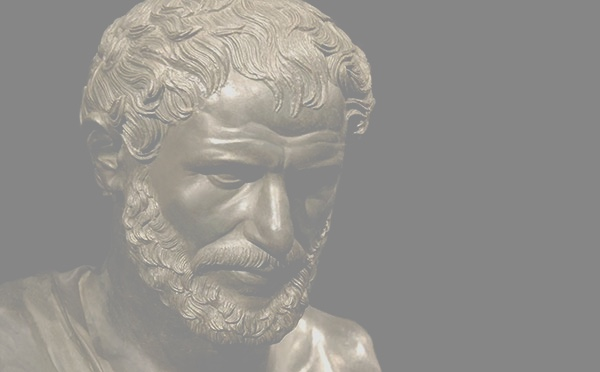
Zeno of Elea, an ancient Greek philosopher, is renowned primarily for his thought experiments that challenge conventional notions of reality. His ideas, preserved primarily through the works of others, are most clearly illuminated in Aristotle’s Physics, which examines and responds to Zeno’s paradoxes of motion.
The first of a handful of paradoxes that Aristotle cites is the “bisection” paradox: Imagine an arrow shot toward a target 100 feet away. To reach the target, the arrow must first cover 50 feet (half the distance). From there, it must travel 25 feet (half of the remaining distance), then 12.5 feet, and so on, with each segment halved infinitely. Since there are always more halfway points to traverse, Zeno argues that the arrow can never complete its journey, rendering motion impossible. Zeno applies similar reasoning to the case of two moving objects in his “Achilles” paradox. Here, the Greek legend Achilles races a tortoise that has been given a head start. Achilles must first reach the tortoise’s starting point, but by the time he does, the tortoise has moved ahead. He must then reach this new point, only to find the tortoise still ahead, and so on ad infinitum. Thus, “the quickest runner. . . must fail in his pursuit of the slowest.” Among the four paradoxes Aristotle attributes to Zeno, each concludes that motion is illusory. The bisection paradox alone, however, offers all the enigma we need.
Whether Zeno genuinely believed that motion was impossible or whether his paradoxes were intended as thought experiments to defend his mentor Parmenides’ view of a changeless reality remains debated. Zeno himself leaves us no explicit clarification. Yet, his arguments push us into a strange corner: the reasoning seems airtight, but the conclusion—that motion does not exist—is indubitably false. We move through the world every day, the arrow will reach its target, and Achilles would, in fact, outrun the tortoise. The difficulty lies in explaining exactly why Zeno’s reasoning fails. It’s a riddle of sorts. We know a solution exists, but getting to it requires us to challenge the very assumptions the paradox is built on.
Many solutions have been proposed, from Aristotle’s own rebuttals to modern mathematical treatments using calculus. But the heart of the issue can be distilled into one principle that I’ve concluded: actual infinities do not correspond to physical reality. In the 1970s, American philosopher William Lane Craig expounded on this reality (and its implications, which we will come to see) by distinguishing between two types of infinity—potential and actual. A potential infinity describes a process that could go on forever without ever being completed. For instance, you can successively add numbers (1, 2, 3, …) indefinitely without termination. An actual infinity, by contrast, is a completed, infinite totality—a set of infinitely many elements that already exists as a whole.
Potential infinities are possible in reality. Time moving into the future is potentially infinite; there will always be another moment after this one. Space can be potentially infinite in the sense that we can, in theory, keep traveling outward without hitting a physical limit. Actual infinities, however, are not possible in our reality. In 1924, the German mathematician David Hilbert posited his popular “Infinite Hotel Paradox,” which goes: Imagine a hotel with infinitely many rooms, all occupied. If a new guest arrives, the hotel can still accommodate them by shifting each guest to the next room (room 1 to room 2, room 2 to room 3, etc.), freeing up room 1. This process can be repeated for any finite number of new guests. Another puzzling issue arises when comparing infinities of different sizes. For example, the infinite set of numbers between zero and one seems half as large as the infinite set of numbers between zero and two. But how can one infinite series of numbers be considered smaller than another infinite series? Evidently, while we can agree on the postulates of infinities in the world of mathematics, absurdities naturally follow from assuming actual infinities exist in the real world, for no correspondence is to be had.
If we reverse the framing, we might say that Zeno’s paradox is not merely resolved by noting that actual infinities don’t correspond to reality, but rather, it becomes further evidence for that very claim. The fact that distances do converge and motion does transpire corroborates why actual infinites accord merely to the theoretical.
This insight has profound implications beyond motion. For millennia before the 20th century, when modern physics revealed that the universe has a beginning, viz. the Big Bang, the question of whether the universe had a beginning was largely left to philosophers. Medieval Jewish and Arab thinkers, including al-Kindi, Saadia Gaon, and al-Ghazali, were revived by Craig, as they were credited for first grappling with this question through pure reason, employing a priori arguments rather than empirical science. If the universe were eternal, stretching back infinitely in time, there would be no need to posit a creator. But if it had a beginning, that beginning would call for an explanation. The Big Bang, after all, is not a cause—it is an effect. The sudden expansion of the universe is an event that happened, and as al-Ghazali notably declared, whatever begins to exist must have a cause.
If the universe began, it could proceed forward as a potential infinity, with time marching endlessly into the future. But if it had no beginning, then time itself would form an actual infinite in the past, and as we’ve established, actual infinites don’t correspond to reality. Furthermore, if the universe had no beginning and an actual infinite number of past moments had already elapsed, we could never arrive at the present moment. For if “the infinite can neither be traversed nor brought to an end;” medieval Arab philosopher, Al-Kindi writes, “then the temporally infinite can never be traversed so as to reach a definite time.” It would be like trying to catch up to the horizon.
A hasty objection would be, “Well, because Zeno’s paradox converges, that proves an infinite past could converge to the present.” Quite the contrary. The very fact that Zeno’s convergence works is antithetical to the idea of an actual infinite. If you tried to compare the convergence in Zeno’s paradox to the temporality of the universe, you would have to follow the same rules. Imagine starting one million years ago, then halving that distance in time, and then halving it again, and again, continuing forever. This, supposedly, would show that we could reach the present through an infinite amount of time because in real life, motion does converge. But that defeats the point, because the illustration only works by having a defined starting point—one million years ago. “In the light of these considerations,” Craig concludes in his work The Kalam Cosmological Argument, “I think we are amply justified in concluding. . . the universe began to exist.”
In short, actual infinities do not exist in our reality. You cannot go infinitely into the past and sidestep a beginning, nor traverse an infinite amount of elapsed time to arrive at the present. With the emergence of the Big Bang as strong empirical evidence for a finite past, philosophical arguments that long predated modern physics have found striking confirmation. This has prompted renewed efforts, particularly among atheists, to rework the understanding of time to evade the conclusion that a beginning requires a first cause. No theories that counter the conventional understanding of time have gained traction; however, it’s a topic I’m interested in exploring down the road.