

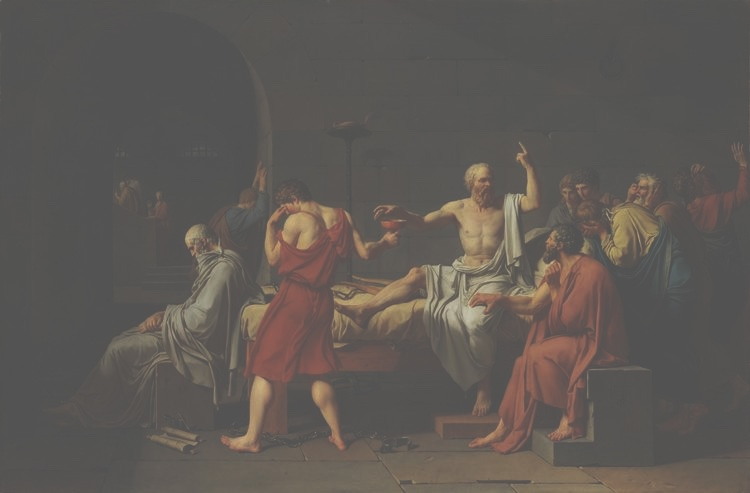
After graduating with my bachelor’s degree in philosophy, I had a philosophy professor who generously purchased me a book she thought I might find interesting. It was by Simone Weil, a French philosopher of the early 20th century. We had looked at her primarily for her politically and economically oriented philosophy, but she was also a learned scholar of religion and mysticism. The book of Weil’s that I was sent is called Intimations of Christianity Among the Ancient Greeks. A breakdown of the title might help explain the entirety of the book. The Classical Greek period was roughly 300–800 years before Christ, and “intimation” means a hint, a subtle inkling of something not yet fully revealed. The Old Testament offers numerous intimations of the New Testament, not just foreshadowing but often prophesying the attributes and indicators of the Messiah to come. What Weil does in this project is scour through the canon of Greek literature—ranging from the epics of Homer, the plays of Sophocles, and the dialogues of Plato—searching for these inklings in ancient Greek culture that would manifest fully at the turn of the era through Christ.
Weil never appears to argue that these are literal prophecies or that Christianity, and Christ in particular, stole redemptive ideas or narrative arcs from the Greeks. In fact, there are no exact replicas, and furthermore, Jewish and Greek cultures reached their culmination almost simultaneously at the turn of the era, so there is no direct evidence that Christ ever read the Greek philosophers.
There is one intimation that Weil touches on, one I had heard before, that offers an uncanny parallel to Christ. It comes from Plato’s Republic, in a dialogue discussing justice: whether people exalt justice because it is good in itself or merely because it is beneficial. If justice is only good because it is beneficial, then if you can prove it is not beneficial, can you conclude it is not good? In this section, Socrates is conversing with others in Athens, and one of the men arguing this position is Glaucon (Plato’s own brother). Speaking as a devil’s advocate, Glaucon claims most people see justice as a grudging social contract—we’re all naturally selfish and would commit injustices freely if we could get away with it. He invokes the myth of the Ring of Gyges, in which a shepherd uses a magic ring that grants invisibility to murder, seduce, and seize a kingdom, proving anyone would do the same without fear of retribution. (I’ve hear some say this story was a point of inspiration for Tolkien’s The Lord of the Rings.) Glaucon argues that justice is a burdensome necessity we praise hypocritically but practice only out of weakness.
If this is confusing, consider a familiar example. We endorse and often abide by safe, lawful driving; however, many people speed or cut corners when cops are presumed to not be around because breaking the rules seems beneficial (faster commute). Glaucon would argue we only follow such rules out of weakness—fear of tickets or crashes—not because slowing down is inherently beneficial or joyful. If you had an invisible car (like the ring), you’d zoom freely.
Here is where we arrive at the quote I mentioned. Glaucon then paints a striking juxtaposition: a perfectly unjust man and a perfectly just man. The perfectly unjust man is a crafty machiavellian, stealthily pulling off crimes while maintaining a spotless reputation of justice in an effort to snag honors, wealth, and power. Opposite him stands the perfectly just man—truly noble, wanting not to seem good, but to be. The perfectly just man, however, is stripped bare and made to appear totally unjust. Glaucon describes him as follows:
“They will claim that in this situation the just man will be whipped and put on the rack, will be thrown into chains and have his eyes burnt out. Finally, after all these injuries, he will be crucified.”
Book II, 361, e
Every detail besides the gouging of the eyes parallels the Christ who was to come in Jesus. Yet by this logic, Glaucon says, the unjust man wins big in happiness and strength, making justice look like a losing proposition. And so the rest of Plato’s Republic commences, as Glaucon dares Socrates to prove that the suffering just man is actually more fulfilled.
Much more could be said about this passage, but I will leave it at that—an intimation of Christianity from the ancient Greeks.